
What Is Die Casting
Published: July 10, 2025
What Is High-Pressure Die Casting?
Principle of high-pressure die casting: high-pressure die casting (HPDC) is a casting process for producing metal parts. The metal is melted at high temperature, and the molten metal is poured through the hopper into the injection channel of the die casting machine; a piston or plunger, pushed forward by hydraulic pressure or pressurized gas, makes the molten metal fill the die cavity, where it is formed and solidified under pressure to give the casting. The die casting machine then opens the die hydraulically, and the aluminum casting is removed. This process is called high-pressure die casting. See the animation of a die casting machine in production below:
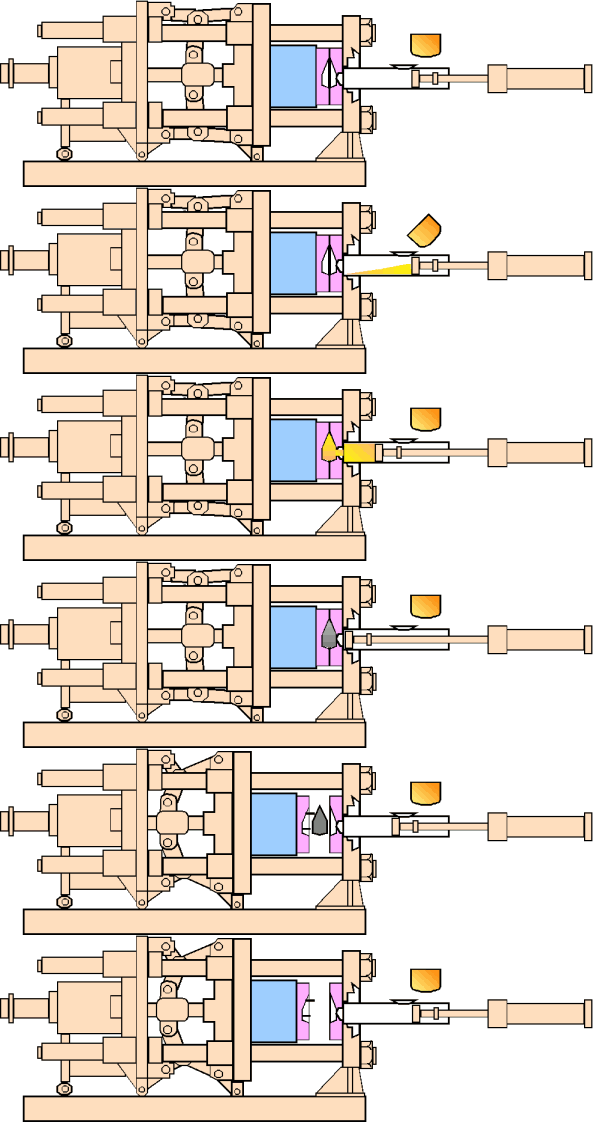
▲ Die casting machine production animation
Process Characteristics of High-Pressure Die Casting
- High pressure: the molten metal fills the cavity under pressure and crystallizes and solidifies at a still higher pressure. Typical pressures are 15-100 MPa, and some even reach 200 MPa, so the pressure range of high-pressure die casting is wide.
- High speed: the molten metal fills the cavity at high speed, usually 10-50 m/s and sometimes more than 80 m/s (the linear velocity at which the metal is introduced into the cavity through the ingate — the ingate speed), so the filling time of the molten metal is extremely short (about 0.01-0.2 s) and the cavity can be filled within it.
- High precision: because of the high speed and high pressure, only high-strength hot-work die steels can be used for the die; die accuracy is high, part accuracy is high and the product surface is smooth.
Advantages and Disadvantages of High-Pressure Die Casting
Advantages of High-Pressure Die Casting
- Castings have high dimensional accuracy and good surface finish, generally equivalent to grades 5–8.
- Strength and hardness are relatively high; strength is generally 25–30% higher than that of sand casting.
- Dimensions are stable and interchangeability is good; thin-walled and complex castings can be die cast.
- Machine productivity is high. For example, a domestically made JⅢ3 horizontal cold-chamber die casting machine can average 600–700 shots in eight hours, and a small hot-chamber die casting machine can average 3,000–7,000 shots per eight hours.
- Die life is long: one die, used for alloy die casting, can reach several hundred thousand shots, even more than a million; mechanization and automation are easy to realize.
- Die castings have high dimensional accuracy and a smooth surface. They are generally used directly without further machining, or with a very small machining allowance, so metal utilization improves and less machining equipment and labor are needed.
Disadvantages of High-Pressure Die Casting
- Because the liquid metal fills the cavity at high speed, the flow is unstable; with the conventional die casting method, porosity tends to form inside the casting, elongation is poor, and heat treatment cannot be carried out.
- Castings with complex internal recesses and projections are difficult to die cast. High-pressure die casting tends to produce more defects.
- It is not suitable for small-batch production: die manufacturing costs are high and productivity is high, so small batches are uneconomical.
- Equipment and die costs are high.
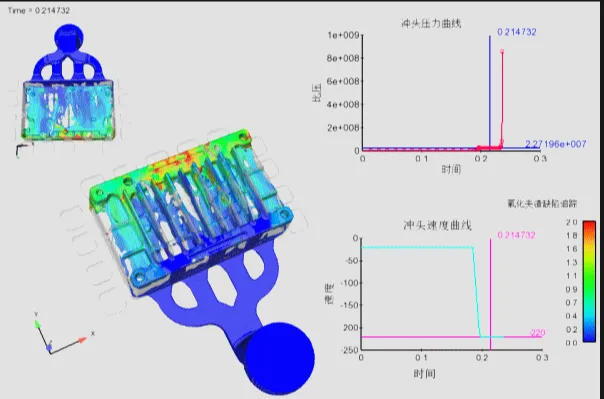
▲ Die casting simulation analysis
Which Metals Can Be Die Cast?
- Aluminum alloy die casting: aluminum is the most common alloying element among die casting metals. By adding iron, aluminum, silicon, copper and other elements, its alloys change the mechanical properties and flow properties of the material, and they are often used to make complex precision parts. Aluminum high-pressure die castings are widely used in the automotive industry and in machinery and equipment, with advantages such as low weight, stable dimensions, corrosion resistance and high thermal conductivity. Common high-pressure die casting aluminum alloys include A360, A380 and ADC12.
- Copper alloy die casting: copper alloys can also be die cast, but because their melting point is relatively high, die life is usually relatively low. Still, because of these metallic properties of copper, some products have to be made of copper alloy, so using the die casting process greatly reduces production costs.
- Other metal die casting: besides the metals above, lead alloys, tin alloys and others are also commonly produced by die casting.
What Problems Can Occur in Die Castings?
- Because the alloy liquid pressed into the die generally cools and solidifies rapidly under non-vacuum conditions, a poorly controlled casting process easily produces defects such as porosity and flow marks.
- Die castings produced by ordinary methods cannot undergo high-temperature heat treatment or welding.
- At present it is still relatively difficult to die cast certain internally recessed parts and high-melting-point alloy castings.
- Die casting equipment is expensive and die manufacture takes a certain period, so single-piece or small-batch production is unsuitable; only in large-volume production are the economic returns good.
What Is the High-Pressure Die Casting Production Process?
- Material selection: according to the customer's product requirements, select a suitable metal material.
- Melting and pouring: melt the selected alloy material in a crucible and feed it through the hopper into the die.
- Die casting: under pressure, the molten alloy liquid fills the die cavity and is formed.
- Cooling and ejection: air or water cooling brings the die down to the required temperature; once the casting has cooled and solidified, the die opens and the part is removed.
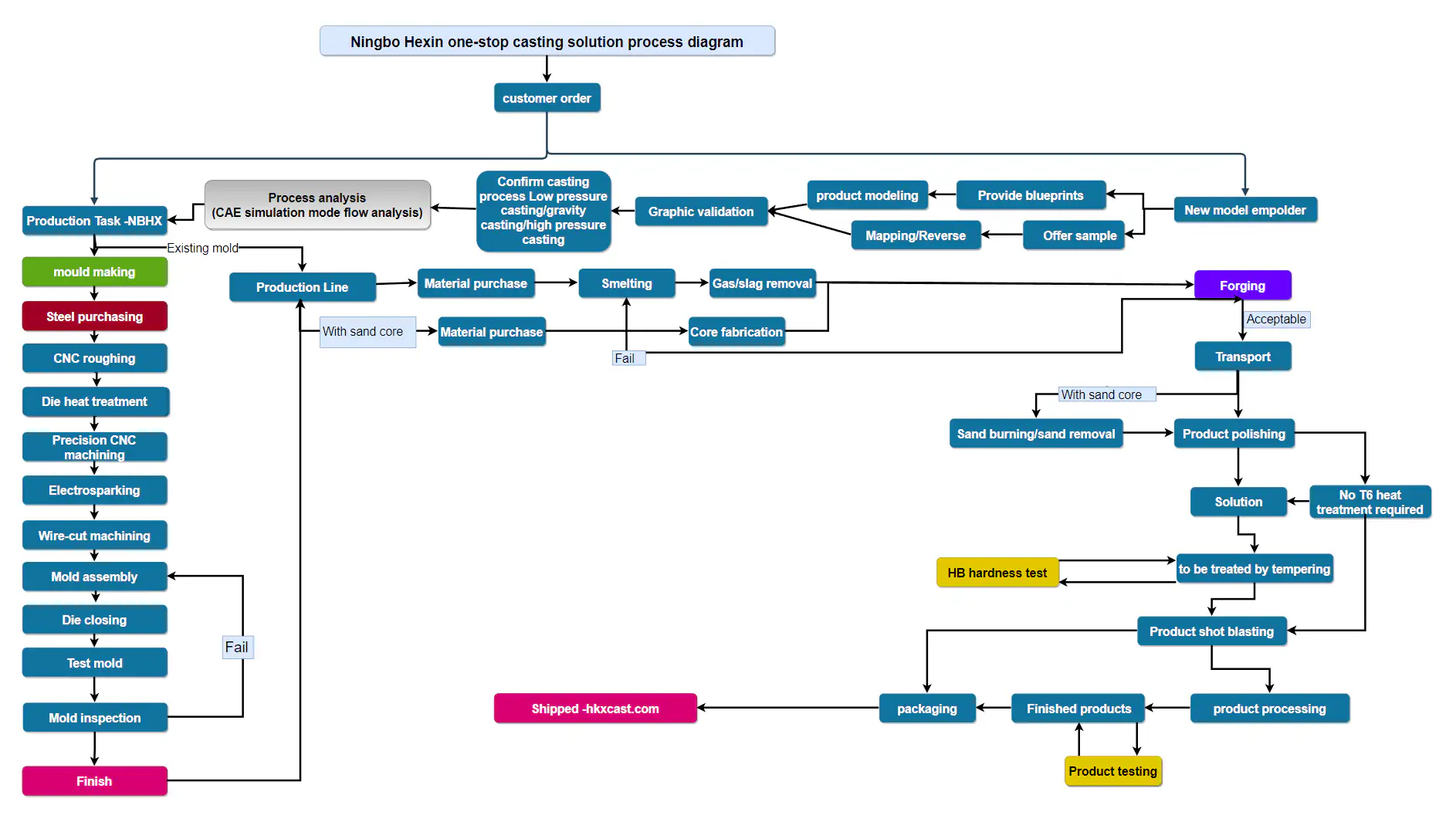
▲ Die casting production flow chart
Types of Die Casting Equipment
By thermal state, die casting machines can be divided into cold-chamber die casting machines and hot-chamber die casting machines.
- Cold-chamber die casting machine: a die casting machine in which the shot chamber and the melting furnace are separate.
- Hot-chamber die casting machine: a die casting machine in which the metal melting and holding unit is integrated with the injection unit.
By orientation, they can be divided into horizontal die casting machines, vertical die casting machines and fully vertical die casting machines.
- Horizontal cold-chamber die casting machine: the shot chamber is placed horizontally and casting is carried out horizontally.
- Vertical cold-chamber die casting machine: the shot chamber is placed vertically and the injection plunger moves vertically, but the clamping unit is still arranged horizontally.
- Fully vertical cold-chamber die casting machine: the shot chamber is placed vertically, the injection plunger moves vertically and the clamping unit is also arranged vertically.
Applications of High-Pressure Die Casting
1. Automotive Industry
Die cast products hold an important position in automotive manufacturing and are widely used in the production of various parts, including engine components (such as cylinder blocks, cylinder heads and crankcases), drivetrain components and chassis components. Aluminum alloy die castings account for more than 30% of the castings in a complete vehicle.
2. Electronics
Die cast products are often used in the manufacture of electronic product housings, such as mobile phones, computers and flat-panel televisions. These products have relatively high requirements for the appearance quality, structural strength and heat dissipation performance of die castings.
3. Furniture and Household Products
Die cast products are also widely used in furniture and household products, such as the housings and parts of refrigerators, color televisions, washing machines and air conditioners. These products have certain requirements for the corrosion resistance and appearance of die castings.
4. Machinery and Equipment
Die cast products play an important role in various industrial equipment, such as machine tools, pumps and valves, and pressure vessels. Such equipment requires die castings with high strength and precision.
Contact
- Mobile / WeChat: +86 199 8304 0872
- Landline: +86 28-8712 5500
- Email: huachuanyazhu@hcyz.email
Address
- Group 7, No. 55, Shuangbai Village, Puyang Subdistrict, Dujiangyan, Chengdu, Sichuan, China
WeCom